Owners & mechanics · Perspective
AI can bring mechanics closer to the work
Clearer requests. Skilled professionals. Fewer layers in between. AI gives smaller teams an opportunity to build repair apps around the work people actually need done.
By FixMyWhip · 4 min read · Published
A direction for better repair apps
Build around the repair
Make the request clearer
Organize what the owner observed and let them correct the details.
Put expertise to work
Help mechanics assess relevant requests and explain the proposed work.
Keep the service focused
Make the scope, costs and next decision easy to understand.
An industry perspective. The AI examples describe proposed uses for repair software.
The gap before the repair
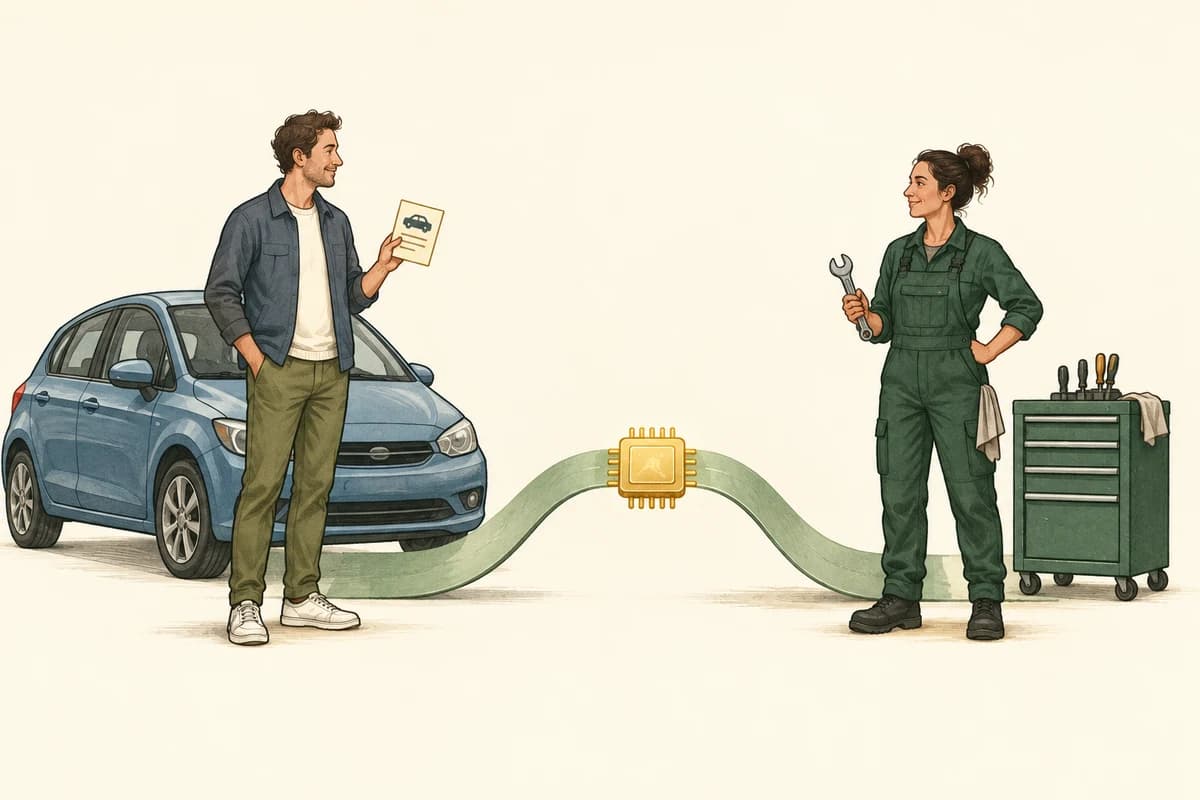
A driver hears a new noise. A mechanic needs to know which vehicle is involved, when the noise happens and what has already been checked. Before anyone picks up a tool, those two people need a useful conversation.
AI could make that conversation easier to start. A repair platform could organize the owner's description, flag a missing detail and prepare a short brief for review. The owner gets help explaining the concern. The mechanic gets a clearer starting point. That is a practical bridge between a person who needs work done and a professional equipped to do it.
Give expertise a better tool
At Microsoft's Build conference in 2016, Satya Nadella described an ambition to build “intelligence that augments human abilities and experiences.” Repair software offers a concrete place to apply that principle.
An assistant could distinguish an observation, such as vibration while braking, from a guess about the cause. It could help prepare questions and explain unfamiliar terms, while keeping the original details visible and correctable. The mechanic still assesses the vehicle, establishes the cause and recommends the work. The useful role for AI is to help that expertise reach the customer with less friction.
Source: Satya Nadella's Build 2016 remarksPrecision means a better fit
A relevant repair job depends on specific things: the vehicle, the concern, the mechanic's skills and equipment, the service location and the time available. A platform built around those details could help mechanics find work that fits their capabilities and help owners compare what each proposal includes.
That precision should continue through the agreement. An assessment and a defined repair have different scopes. An estimated completion time and a confirmed appointment carry different commitments. Clear records give the mechanic room to explain what needs checking and the owner a sound basis for deciding what to approve.
A focused platform can come from a smaller team
AI also changes what is possible for the people building the platform. In a 2023 controlled experiment, developers given GitHub Copilot completed a specified programming task faster than the comparison group. One task cannot establish the cost of running a software company, but it demonstrates how assistance can reduce part of the work of development.
Where those gains hold up in practice, a smaller team has more room to build and improve a useful service. It can concentrate on a connected set of tasks: describe the concern, review proposals, agree on the work and keep the repair record together. A precise product can serve that journey without inheriting a large company's layers of coordination.
Source: Controlled study of AI assistance on a programming taskLess overhead can leave room for a simpler app
David Heinemeier Hansson made the case for deliberate scale in a 2015 essay: “Small is a great destination in itself.” AI gives software builders another reason to consider staying focused. If a product takes fewer resources to build and maintain, its creators have more choices about how to sustain it.
That opens a possibility worth pursuing: repair apps without advertising, layers of paid upgrades or extra subscriptions attached to every useful action. People could arrive with a repair need, work with a professional and finish the task without a trail of unrelated offers.
Lower development costs alone will not produce that future. Infrastructure, security, payment handling, maintenance and human support still need funding. A company has to choose a business model that covers those costs while keeping the service useful. AI can create room for simplicity; builders have to use it.
Source: David Heinemeier Hansson on choosing the right company sizeJudge the platform by the work it helps complete
For platforms such as FixMyWhip, the ambition is a clearer connection between owners and professional mechanics: useful information, suitable work, an understandable agreement and someone accountable when a problem needs attention. These are the outcomes that make a repair platform worth using.
AI could help smaller teams build that bridge. The next generation of repair apps should earn its place by helping people get the job done.